

In today’s digital economy, businesses are rapidly shifting from traditional IT systems to flexible online environments. SYNEXRA TECHNOLOGY SOLUTIONS CO., LTD. helps organizations understand and adopt modern technologies such as cloud infrastructure, enabling them to scale efficiently, reduce costs, and enhance security. As companies increasingly rely on digital platforms, cloud infrastructure has become a critical foundation for innovation and growth.
This guide explains what cloud infrastructure is, how it works, its key components, benefits, and why modern businesses should consider adopting it.
What Is Cloud Infrastructure?
Cloud infrastructure refers to the collection of hardware and software components that enable cloud computing services. These components include servers, storage systems, networking equipment, virtualization software, and management tools hosted in data centers and accessed through the internet.
Instead of maintaining physical servers and IT equipment on-site, businesses can access computing resources on demand through cloud providers. This means companies can run applications, store data, and manage workloads without needing to invest heavily in physical infrastructure.
Cloud infrastructure forms the backbone of cloud services such as:
- Infrastructure as a Service (IaaS)
- Platform as a Service (PaaS)
- Software as a Service (SaaS)
By leveraging cloud infrastructure, organizations gain flexibility and scalability that traditional IT systems cannot easily provide.

Key Components of Cloud Infrastructure
To understand how cloud infrastructure works, it is helpful to explore the essential components that make up this ecosystem.
Compute Resources
Compute resources refer to the processing power used to run applications and workloads in the cloud.
These include:
- Virtual machines (VMs)
- Containers
- Serverless computing environments
Cloud providers allocate compute power dynamically, allowing businesses to scale resources up or down based on demand.

Storage Systems
Cloud storage enables businesses to store data securely and access it from anywhere with an internet connection.
Common types of cloud storage include:
- Object storage
- Block storage
- File storage
These storage solutions are designed for high durability and availability, making them ideal for data-heavy applications.

Networking Infrastructure
Networking connects different cloud resources and allows data to travel between users, applications, and services.
Key networking components include:
- Virtual networks
- Load balancers
- Firewalls
- Content delivery networks (CDNs)
Cloud networking ensures fast, reliable, and secure communication across cloud systems.

Virtualization Technology
Virtualization is a core technology behind cloud infrastructure. It allows multiple virtual machines to run on a single physical server.
This maximizes hardware efficiency and enables cloud providers to offer scalable computing resources without dedicating physical machines to individual users.
Management and Automation Tools
Cloud infrastructure also includes tools for monitoring, management, automation, and security.
These tools allow businesses to:
- Monitor system performance
- Automate resource provisioning
- Track usage and costs
- Implement security policies
Automation plays a major role in modern cloud environments, enabling faster deployment and improved operational efficiency through DevOps automation practices in modern IT operations.
Types of Cloud Infrastructure
Organizations can deploy cloud infrastructure in several ways depending on their needs, security requirements, and budget.
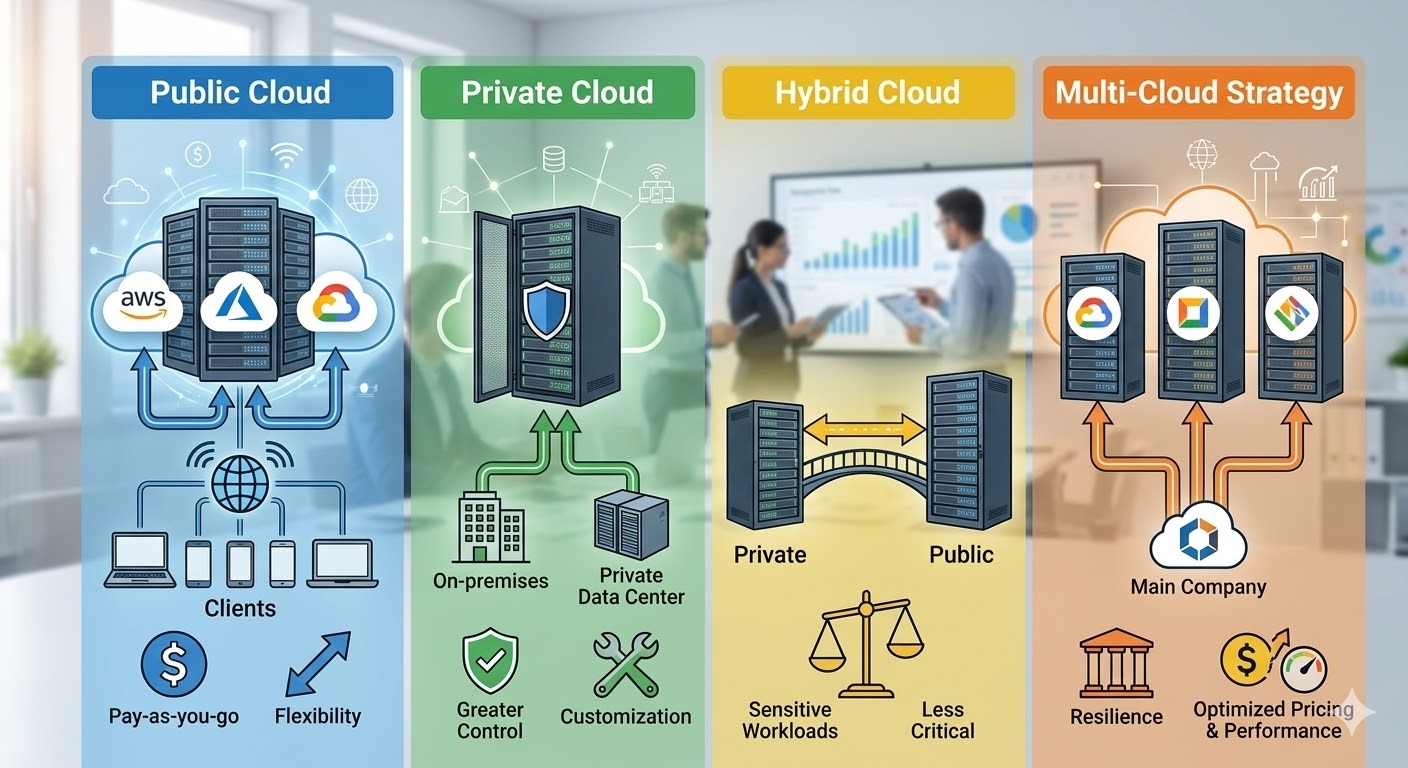
Public Cloud
Public cloud infrastructure is owned and managed by third-party providers such as AWS, Microsoft Azure, or Google Cloud.
In this model:
- Resources are shared across multiple customers
- Users pay only for what they use
- Infrastructure is accessible through the internet
Public clouds are ideal for startups and businesses that want scalability without large upfront investments.
Private Cloud
Private cloud infrastructure is dedicated to a single organization.
It can be hosted:
- On-premises
- In a private data center
- By a third-party provider
Private clouds offer greater control, customization, and security, making them suitable for industries with strict compliance requirements.
Hybrid Cloud
Hybrid cloud infrastructure combines public and private cloud environments.
Businesses can run sensitive workloads in private clouds while using public cloud resources for less critical tasks or additional computing power.
This approach provides flexibility and cost efficiency while maintaining data security.
Multi-Cloud Strategy
A multi-cloud strategy involves using services from multiple cloud providers simultaneously.
Benefits include:
- Reduced dependency on a single provider
- Improved reliability
- Optimized pricing and performance
Many modern enterprises adopt multi-cloud infrastructure to enhance resilience and avoid vendor lock-in.
Benefits of Cloud Infrastructure for Businesses
Adopting cloud infrastructure provides numerous advantages that support business growth and innovation.
Scalability and Flexibility
One of the biggest advantages of cloud infrastructure is the ability to scale resources instantly.
Businesses can increase computing power during peak demand and reduce it when demand decreases, ensuring efficient resource utilization.
Cost Efficiency
Traditional IT infrastructure requires large upfront investments in hardware, maintenance, and upgrades.
Cloud infrastructure eliminates many of these costs by offering a pay-as-you-go model, where businesses only pay for the resources they actually use.
This makes cloud solutions especially attractive for small and medium-sized enterprises.
Improved Reliability and Availability
Leading cloud providers operate globally distributed data centers designed for high availability.
Features such as redundancy, automated backups, and disaster recovery ensure minimal downtime and continuous operations.
Enhanced Security
Modern cloud platforms provide advanced security measures including:
- Data encryption
- Identity and access management
- Threat detection
- Security monitoring
While security responsibilities are shared between providers and customers, cloud infrastructure often provides stronger security than many on-premise systems.
Faster Deployment
Cloud infrastructure allows businesses to deploy applications and services quickly without purchasing or configuring physical hardware.
This speed accelerates innovation and helps companies bring new products to market faster.

Cloud Infrastructure vs Traditional IT Infrastructure
Understanding the differences between cloud infrastructure and traditional infrastructure helps organizations make informed technology decisions.
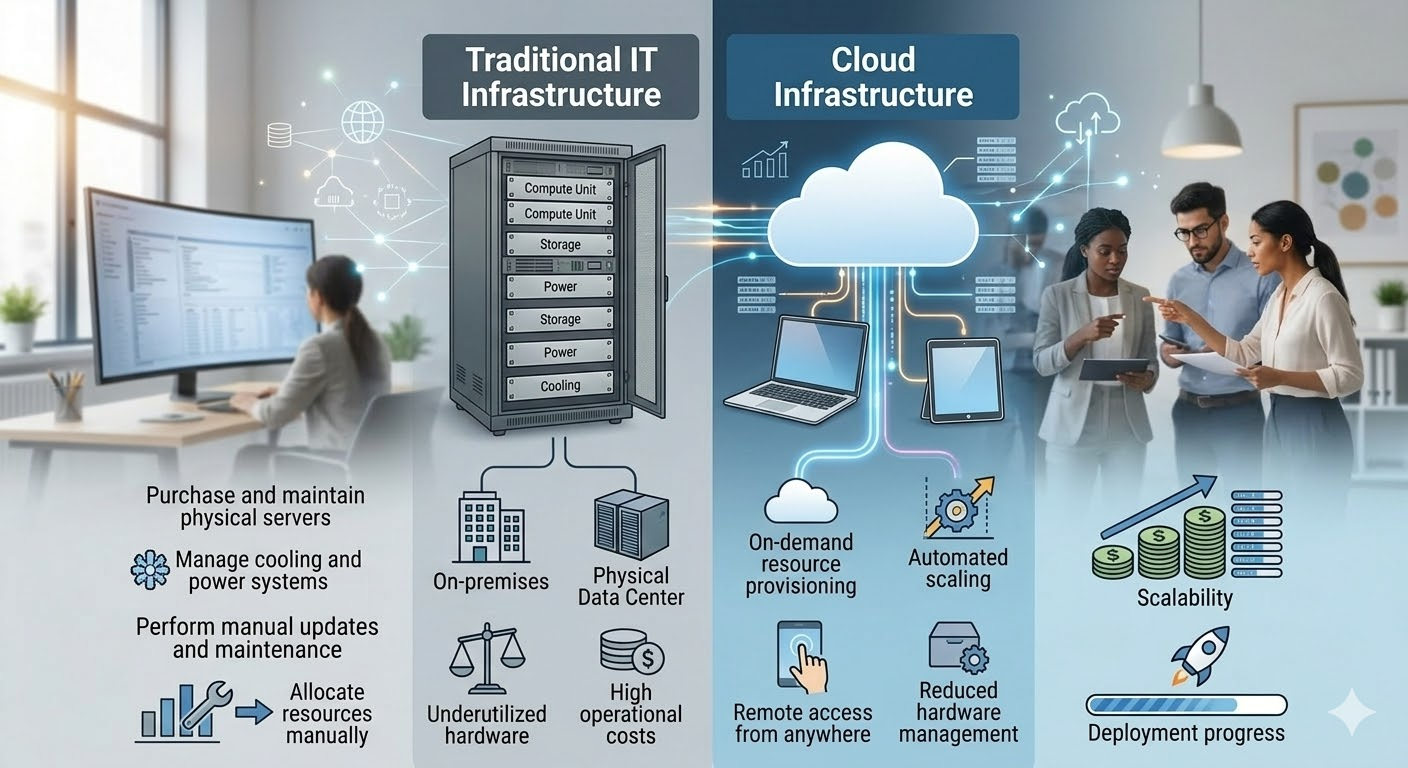
Traditional Infrastructure
Traditional IT systems require companies to:
- Purchase and maintain physical servers
- Manage cooling and power systems
- Perform manual updates and maintenance
- Allocate resources manually
This model often leads to underutilized hardware and high operational costs.
Cloud Infrastructure
In contrast, cloud infrastructure offers:
- On-demand resource provisioning
- Automated scaling
- Remote access from anywhere
- Reduced hardware management
These features make cloud environments more adaptable to modern business needs.
Common Use Cases of Cloud Infrastructure
Cloud infrastructure supports a wide range of business applications across industries.
Web Hosting and Applications
Many websites and online services run entirely on cloud infrastructure due to its scalability and reliability.
Cloud platforms allow companies to handle sudden spikes in traffic without performance issues.
Data Storage and Backup
Cloud storage solutions are widely used for secure data backup and disaster recovery.
Businesses can protect critical information while ensuring quick recovery during system failures.
Big Data and Analytics
Cloud infrastructure enables organizations to process massive amounts of data using advanced analytics tools.
Companies can gain valuable insights without investing in expensive hardware.
Software Development and Testing
Developers often use cloud environments to build, test, and deploy applications.
Cloud-based development environments allow teams to collaborate remotely and accelerate software delivery.
Artificial Intelligence and Machine Learning
Many AI and machine learning workloads require significant computing power.
Cloud infrastructure provides scalable resources that allow organizations to train models and process data efficiently.

Challenges of Cloud Infrastructure
While cloud infrastructure offers many advantages, businesses should also consider potential challenges.
Security and Compliance
Although cloud providers invest heavily in security, organizations must still ensure proper configuration and compliance with industry regulations.
Misconfigured cloud resources can lead to vulnerabilities.
Cost Management
Without proper monitoring, cloud costs can grow unexpectedly due to unused or over-provisioned resources.
Implementing cost management strategies is essential for maintaining budget control.
Vendor Lock-In
Relying heavily on a single cloud provider can create challenges when migrating to other platforms.
Adopting hybrid or multi-cloud strategies can help mitigate this risk.
Performance Considerations
Cloud performance depends on network connectivity and infrastructure configuration.
Businesses must carefully design their architecture to achieve optimal performance.
Best Practices for Implementing Cloud Infrastructure
Organizations planning to adopt cloud infrastructure should follow best practices to maximize benefits and minimize risks.
Assess Business Needs
Before migrating to the cloud, companies should evaluate:
- Workload requirements
- Security needs
- Compliance standards
- Budget constraints
This assessment helps determine the most suitable cloud deployment model.
Implement Strong Security Policies
Security should be integrated into every stage of cloud infrastructure deployment.
Best practices include:
- Using strong authentication methods
- Encrypting sensitive data
- Monitoring system activity
- Conducting regular security audits
Optimize Costs
Cost optimization strategies include:
- Monitoring resource usage
- Using auto-scaling features
- Removing unused resources
- Selecting appropriate pricing models
Train IT Teams
Cloud environments require different skills compared to traditional IT systems.
Providing training for IT teams ensures smooth adoption and effective management of cloud infrastructure.
The Future of Cloud Infrastructure
Cloud infrastructure continues to evolve rapidly as businesses demand greater scalability, automation, and performance.
Emerging trends include:
- Edge computing
- Serverless architecture
- AI-driven infrastructure management
- Sustainable data centers
These innovations will further enhance the capabilities of cloud computing and enable organizations to build more intelligent digital systems as more companies adopt cloud migration strategies for modern businesses.
As digital transformation accelerates worldwide, cloud infrastructure will remain a cornerstone of modern IT strategies.
Conclusion
Modern organizations require technology platforms that are scalable, secure, and efficient. Cloud infrastructure provides the foundation for delivering these capabilities while reducing the complexity of managing traditional IT systems.
From hosting applications to powering data analytics and artificial intelligence, cloud infrastructure enables businesses to innovate faster and operate more efficiently in a competitive digital landscape.
With expert guidance from SYNEXRA TECHNOLOGY SOLUTIONS CO., LTD., companies can successfully adopt cloud infrastructure strategies that align with their business goals and future growth plans.