

In the rapidly evolving digital world, organizations must deliver software faster, more reliably, and with greater efficiency. Traditional software development methods often struggle to keep pace with modern demands. This is where DevOps comes in. Companies like SYNEXRA TECHNOLOGY SOLUTIONS CO., LTD. help businesses adopt DevOps practices to streamline development workflows, improve collaboration, and accelerate innovation. By integrating development and operations, DevOps has become a transformative force in modern software development.
This guide explores how DevOps is transforming modern software development, the principles behind it, its benefits, and why businesses across industries are embracing this approach.
What Is DevOps?
DevOps is a set of practices, cultural philosophies, and tools that bring together software development (Dev) and IT operations (Ops). The goal of DevOps is to shorten the software development lifecycle while delivering high-quality software continuously.
Traditionally, development teams and operations teams worked separately. Developers focused on building features, while operations teams managed deployment and infrastructure. This separation often caused delays, communication gaps, and inefficiencies.
DevOps removes these barriers by encouraging collaboration, automation, and shared responsibility throughout the entire software lifecycle.
Key objectives of DevOps include:
- Faster software delivery
- Improved collaboration between teams
- Increased automation
- Higher reliability and stability of systems
Today, DevOps is widely adopted by startups, enterprises, and technology companies aiming to improve their software development processes.

The Evolution of Software Development
To understand the impact of DevOps, it is helpful to examine how software development practices have evolved over time.
Traditional Waterfall Development
In the early days of software engineering, many organizations followed the Waterfall model, where development occurred in sequential stages:
- Requirements gathering
- Design
- Development
- Testing
- Deployment
- Maintenance
While this approach worked for some projects, it often resulted in long development cycles and limited flexibility when requirements changed.
Agile Development
The Agile methodology emerged to address these limitations. Agile promotes iterative development, collaboration, and continuous feedback.
However, even with Agile, many companies still faced challenges when moving code from development to production environments.
The Rise of DevOps
DevOps evolved as a solution to bridge the gap between Agile development and IT operations. By integrating these teams and automating processes, DevOps enables continuous delivery and faster innovation through modern IT automation practices.
This transformation has fundamentally changed how software is developed, deployed, and maintained.

Core Principles of DevOps
Successful DevOps implementation relies on several core principles that guide teams toward efficiency and collaboration.
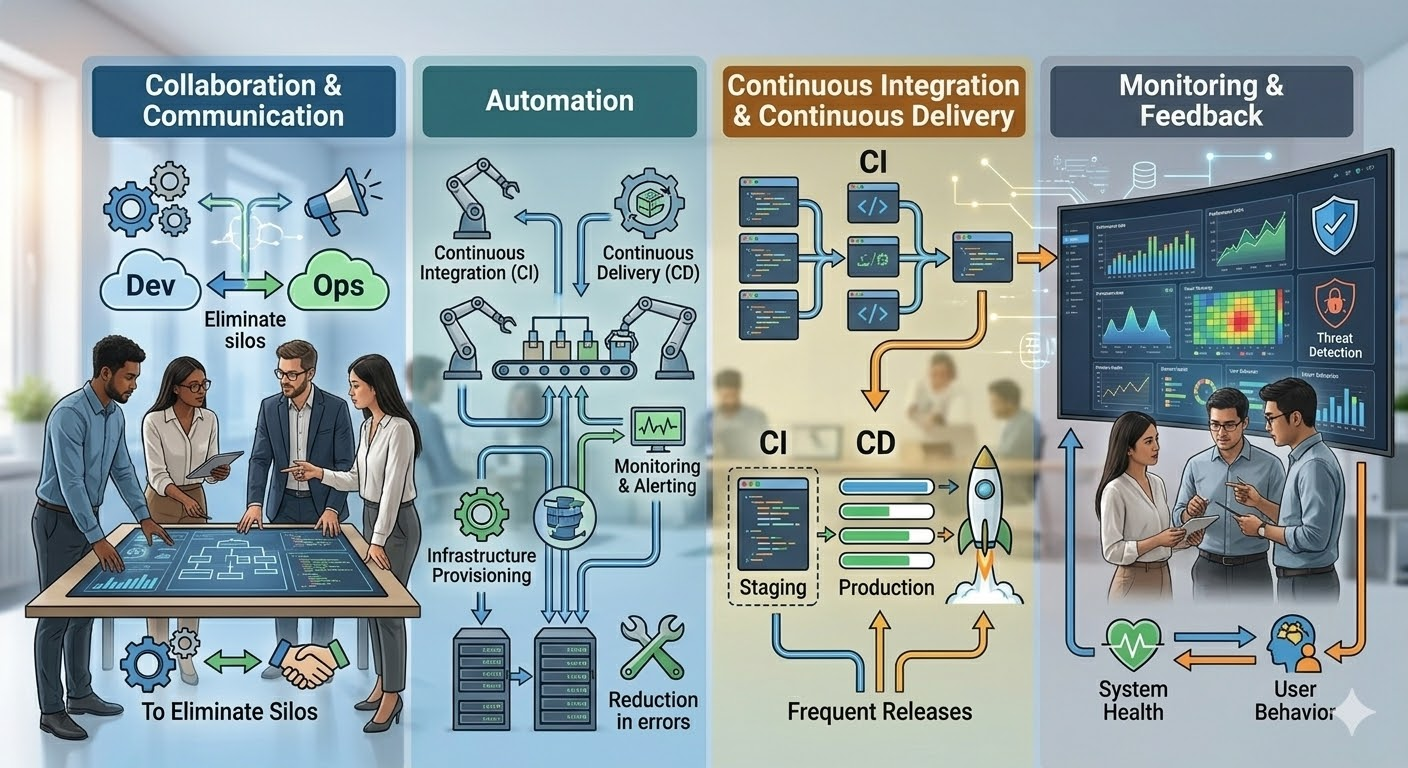
Collaboration and Communication
DevOps promotes strong collaboration between developers, operations teams, security professionals, and other stakeholders.
Instead of working in isolated departments, teams share responsibility for the entire application lifecycle.
This cultural shift helps eliminate bottlenecks and improves problem-solving.
Automation
Automation is a key component of DevOps. Repetitive tasks such as testing, integration, and deployment can be automated to improve speed and reliability.
Common automated processes include:
- Continuous Integration (CI)
- Continuous Delivery (CD)
- Infrastructure provisioning
- Monitoring and alerting
Automation reduces human errors and ensures consistent results across environments.
Continuous Integration and Continuous Delivery
Continuous Integration (CI) involves automatically integrating code changes into a shared repository several times a day.
Continuous Delivery (CD) ensures that applications can be deployed to production quickly and safely.
Together, CI/CD pipelines enable teams to release software updates more frequently.
Monitoring and Feedback
DevOps emphasizes continuous monitoring of systems and applications.
Monitoring tools provide insights into:
- Application performance
- System health
- User behavior
- Security threats
This feedback loop helps teams detect issues early and continuously improve their software.
Key DevOps Practices
DevOps practices help organizations build efficient and scalable development pipelines.
Infrastructure as Code (IaC)
Infrastructure as Code allows teams to manage and provision infrastructure using code instead of manual processes, especially when working with scalable cloud infrastructure environments.
Benefits include:
- Faster environment setup
- Consistent configurations
- Reduced deployment errors
Popular IaC tools include Terraform, AWS CloudFormation, and Ansible.
Continuous Testing
Testing is integrated throughout the development pipeline to ensure code quality and stability.
Types of automated testing include:
- Unit testing
- Integration testing
- Performance testing
- Security testing
Continuous testing ensures that software meets quality standards before deployment.
Microservices Architecture
Many DevOps environments use microservices architecture, where applications are divided into smaller, independent services.
This approach allows teams to develop, deploy, and scale components independently.
Containerization
Containers package applications and their dependencies into lightweight, portable units.
Technologies like Docker and Kubernetes help teams deploy applications consistently across different environments.
Containerization supports scalability and improves resource efficiency.

Benefits of DevOps for Modern Businesses
DevOps offers numerous advantages that help organizations stay competitive in the digital age.
Faster Time to Market
By automating development and deployment processes, DevOps allows companies to release software updates more frequently.
This faster release cycle helps businesses respond quickly to market demands and customer feedback.
Improved Collaboration
DevOps breaks down silos between teams, encouraging open communication and shared responsibility.
This collaborative environment improves productivity and reduces misunderstandings.
Higher Software Quality
Continuous testing and automated quality checks help detect issues earlier in the development process.
As a result, DevOps teams can deliver more reliable and stable software.
Increased Efficiency
Automation eliminates repetitive manual tasks, allowing developers and operations teams to focus on innovation and strategic improvements.
This efficiency leads to better resource utilization and reduced operational costs.
Enhanced Security
Modern DevOps practices incorporate security throughout the development lifecycle, often referred to as DevSecOps.
Security checks are integrated into CI/CD pipelines, helping teams identify vulnerabilities early.

DevOps Tools That Enable Transformation
A wide range of tools support DevOps workflows and automation.
Version Control Systems
Version control systems track code changes and enable collaboration among developers.
Popular tools include:
- Git
- GitHub
- GitLab
- Bitbucket
CI/CD Tools
CI/CD tools automate the build, testing, and deployment processes.
Examples include:
- Jenkins
- GitHub Actions
- GitLab CI/CD
- CircleCI
Container Platforms
Containers are essential in modern DevOps environments.
Common platforms include:
- Docker
- Kubernetes
- OpenShift
These technologies enable scalable and consistent deployments.
Monitoring and Logging Tools
Monitoring tools provide real-time insights into application performance and system health.
Popular solutions include:
- Prometheus
- Grafana
- ELK Stack
- Datadog
These tools help teams identify issues and maintain system reliability.

Challenges in DevOps Adoption
While DevOps provides significant benefits, organizations may face challenges during implementation.
Cultural Resistance
DevOps requires a shift in mindset and collaboration across teams.
Organizations with rigid structures may find it difficult to adapt initially.
Skill Gaps
DevOps involves a combination of development, operations, and automation skills.
Companies may need to train their teams or hire experienced professionals.
Tool Complexity
The DevOps ecosystem includes many tools and platforms.
Choosing the right combination of tools can be challenging without proper planning.
Security Considerations
Rapid deployments can introduce security risks if not properly managed.
Integrating security practices into DevOps workflows is essential for protecting systems and data.
Best Practices for Implementing DevOps
Organizations can successfully adopt DevOps by following proven best practices.
Start with Small Projects
Begin DevOps implementation with small pilot projects to test workflows and tools.
This approach allows teams to learn and refine processes before scaling.
Encourage Collaboration
Building a DevOps culture requires strong communication between teams.
Regular meetings, shared tools, and cross-functional collaboration improve efficiency.
Invest in Automation
Automation is the foundation of DevOps.
Automating testing, integration, and deployment processes reduces manual errors and speeds up development cycles.
Monitor and Optimize
Continuous monitoring helps organizations identify performance issues and improve system reliability.
Data-driven insights enable teams to optimize their DevOps pipelines.
The Future of DevOps in Software Development
DevOps continues to evolve as technology advances.
Emerging trends include:
- AI-driven DevOps (AIOps)
- Serverless computing
- Edge computing
- GitOps workflows
- DevSecOps integration
These innovations will further enhance automation, reliability, and scalability in software development.
As organizations pursue digital transformation, DevOps will remain a critical strategy for building resilient and agile technology systems.

Conclusion
DevOps has revolutionized the way modern software is developed, deployed, and maintained. By fostering collaboration, automation, and continuous improvement, DevOps enables organizations to deliver high-quality software faster than ever before.
From startups to global enterprises, businesses are adopting DevOps to accelerate innovation, enhance efficiency, and remain competitive in a rapidly changing digital landscape.
With expert guidance from SYNEXRA TECHNOLOGY SOLUTIONS CO., LTD., organizations can successfully implement DevOps strategies that transform their software development processes and support long-term digital growth.